
What a medical evacuation from Africa actually costs
August 21, 2026· By InsuranceSafari Research Team· Safari Travel Insurance editorial team· 10 min read
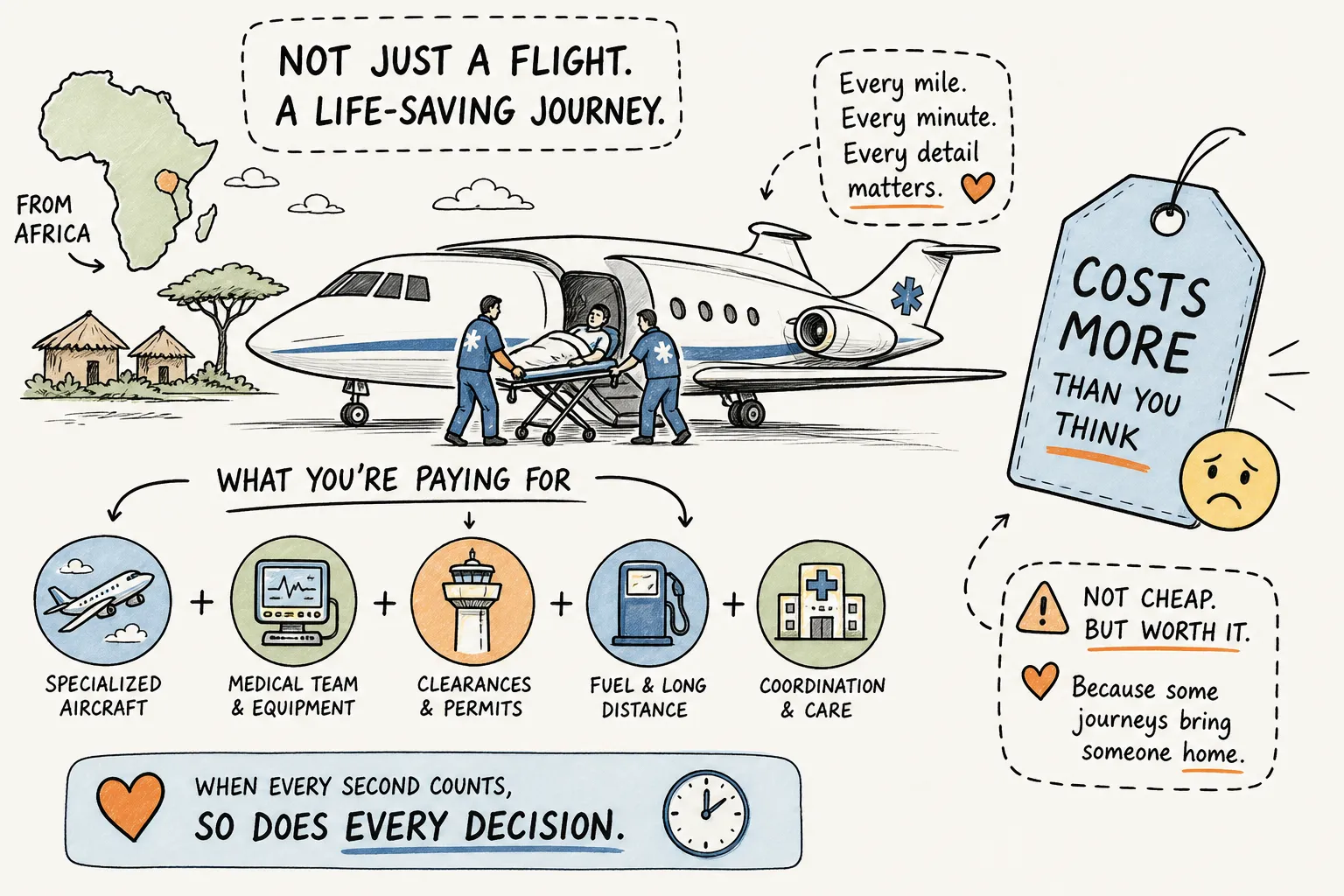
If you're wondering how much a medical evacuation from Africa costs, one documented case gives you a useful starting point: a fit, healthy traveller, a safari in Tanzania, one accident, and a total bill of $282,000 (approximately £220,000). That figure is not a worst-case projection from an insurer's small print. It is a documented case breakdown: $12,000 for the bush plane to Dar es Salaam, $210,000 for the medical flight, $45,000 for ICU support in the air, and $15,000 for permits and coordination. The patient made it home. The policy limit reportedly did not cover the full invoice.
Most travel insurance policies include medical evacuation. That sentence is true, and it is also where the misunderstanding begins. Coverage existing and coverage being adequate are two very different things. The ceiling on that coverage is where travellers get caught out, and Africa is where the ceiling gets tested hardest. This article gives you real price ranges for the cost of medical evacuation from Africa, explains what drives the bill to those levels, and tells you exactly what to look for in a policy before you board. Safari Travel Insurance evaluates evacuation limits across vetted insurance partners specifically for African itineraries, that resource appears in the final section.
How much does a medical evacuation from Africa cost: real price ranges
The numbers vary significantly depending on where the emergency begins, where the patient needs to end up, and how serious the medical situation is. The clearest way to understand the range is to look at it in stages.
At the lower end, an in-country or regional transfer feels manageable until you see the full picture. A bush plane from a remote camp to a city hospital in Tanzania runs approximately $12,000 (around £9,500) on its own. A dedicated air ambulance from Nairobi to Johannesburg typically costs between $35,000 and $60,000 (approximately £27,000, £46,000). These figures are not alarming until you realise they are rarely the end of the story. They are usually the first invoice of several.
Long-haul repatriation to the UK or the United States is where the bill climbs to a level that most people are entirely unprepared for. A dedicated ICU-equipped air ambulance from Nairobi to London typically starts at £90,000, with the broader range sitting between £60,000 and £120,000. Sub-Saharan Africa to a European capital runs approximately $120,000 to $220,000 (around £92,000, £169,000). Africa to the United States: $125,000 to $300,000 (approximately £96,000, £230,000). These are not exceptional air evacuation quotes. They reflect the measurable cost drivers of any long-haul medevac: aircraft positioning and flight hours, fuel across intercontinental distances, specialist clinical staffing, and landing and overflight permits accumulated across multiple jurisdictions. All figures are approximate conversions at current rates.
The Tanzania-to-New York case at $282,000 illustrates exactly how the components stack. It is not an outlier. Published mission cost data tracking medevac operations across the African continent puts the average cost per mission at around $133,000, a typical emergency, not an extraordinary one.
What drives a medical evacuation from Africa cost so high
The aircraft is the largest single item on any medevac invoice. A long-range jet capable of a transatlantic ICU mission costs far more to operate than a regional light charter. That cost includes the aircraft itself, fuel, flight hours, positioning, the aircraft has to get to you before it can take you anywhere, and handling fees at intermediate stops. There is no shortcut around those mechanics. The longer the route and the larger the aircraft required, the bigger that line item becomes.
The medical crew is the second material cost, and it can surprise travellers who assume a medevac simply means a seat on a fast plane. A dedicated air ambulance carries a physician and a critical-care nurse at minimum; complex cases may require a cardiac, paediatric, or neonatal specialist. That clinical team is sometimes bundled into the mission price and sometimes billed separately, but either way it represents a real and substantial share of the total air ambulance Africa price.
Permits, ground transfers, and coordination are smaller individually but add up meaningfully on a complex Africa-to-UK routing. An international medevac crosses multiple airspaces, each requiring landing clearances and overflight permissions. Ground ambulances are needed at both ends: hospital to airport at departure, airport to receiving facility at destination. Case management overhead, covering bed-to-bed coordination, documentation, and customs support, rounds out the invoice. On a straightforward regional flight these are modest costs; on a multi-jurisdiction long-haul mission they become a visible line item.
Why standard policy limits often fall short of the medical evacuation cost from Africa
Some policies marketed to Africa travellers carry medical evacuation limits of $100,000 to $250,000. That range looks substantial on a product page. Measured against an actual invoice, the picture changes quickly. A Nairobi-to-London evacuation starting at £90,000 sits near the top of a $250,000 limit before any ground transfers, specialist crew, or permit costs are added. A full Tanzania-to-New York mission at $282,000 exceeds it entirely.
That gap is not a technicality. It is the difference between coming home without a debt and coming home with a six-figure shortfall after the most frightening experience of your life. The limit looks adequate in a brochure. It does not hold up against an actual invoice.
Exclusions compound the problem. The most common claim-killer is an undeclared pre-existing condition. If you did not declare it when you bought the policy, the insurer is not obligated to cover it, even in a genuine emergency. Travel to a region against UK Foreign, Commonwealth and Development Office advice, activities not listed on the policy, and costs the insurer deems not medically necessary are all grounds for denial. Procedure matters as well. Most policies require you to contact the emergency assistance line before evacuation is arranged. Bypassing that step, even in a crisis with limited communications, can jeopardise the claim entirely.
A genuinely protective policy for remote Africa travel carries an evacuation limit well above $250,000, ideally unlimited or with a ceiling closer to £1 million, and includes 24/7 emergency assistance with the authority to arrange transport directly rather than requiring the traveller to pay out of pocket and claim back. Policies that bundle medical treatment and evacuation under a single high limit, such as £5 million or £10 million for emergency medical expenses and repatriation, are generally stronger than those that separate evacuation as a distinct and capped sub-limit.
Why remote safari destinations push costs even higher
The most sought-after safari destinations in Africa are remote by design. The Okavango Delta in Botswana, South Luangwa in Zambia, and the Selous in Tanzania are not near international airports. Access is by light aircraft, and that same light aircraft becomes the first link in an evacuation chain when something goes wrong. In the Tanzania case, the $12,000 bush plane to Dar es Salaam was just the opening invoice.
A medical emergency at a remote camp begins with a bush flight to a regional airstrip, then a transfer to a larger facility, then potentially a long-haul air ambulance. Each leg adds time and cost. Time matters acutely in a medical emergency; cost matters when it accumulates across four separate transport events. The remoteness that makes these destinations extraordinary is precisely what makes medical repatriation so operationally complex and expensive.
There is a related coverage gap worth checking before departure. Some standard travel insurance policies exclude light aircraft entirely or require the operator to hold specific licences. If the policy does not explicitly cover bush flights, the first link in any evacuation chain may not be covered at all. That exclusion sits quietly in the policy wording until the moment it matters most. Many safari itineraries include scheduled bush flights between camps as a matter of routine, so this is not a theoretical edge case, it is a standard feature of African safari travel that requires explicit confirmation in the policy.
How to verify your evacuation coverage before you depart
Reading a policy document is not the same as understanding whether it will hold up in a remote camp in Zambia. These are the specific questions worth asking before you travel.
What is the medical evacuation sub-limit, and does it apply separately from the broader medical treatment limit?
Does the policy cover evacuation from remote locations with limited infrastructure, not just established commercial airports?
Is there a 24/7 assistance line with the authority to arrange evacuation directly, or must you pay first and claim later?
Are bush flights on licensed light aircraft explicitly included, or excluded by default?
Does the policy require pre-authorisation before arranging transport, and what happens when communication from a remote camp is not possible?
Safari Travel Insurance compares vetted partners on these criteria specifically for African itineraries, evacuation limits, bush flight coverage, and claim procedures designed for destinations with limited infrastructure. Rather than working through generic policy documents in isolation, travellers can use that comparison to identify which partners carry evacuation limits capable of covering a long-haul medevac and which carry sub-limits that leave a meaningful gap.
What to do with this information
The cost of a medical evacuation from Africa is not a theoretical risk. Published mission data puts the average medevac cost across the continent at over $100,000. A full long-haul case regularly exceeds $280,000. Given that Nairobi-to-Johannesburg missions commonly cost $35,000, $60,000, a $100,000, $250,000 evacuation limit may cover a regional hop, but it will not cover an ICU flight from Tanzania to New York costing $125,000, $300,000. That shortfall is the financial exposure that catches travellers out, often after the most expensive itinerary they have ever booked.
The answer is straightforward: know your evacuation limit before you travel, not after an emergency. Check the policy against the real numbers in this article. Verify the bush flight coverage explicitly. Confirm the assistance line has the authority to act, not just to advise. These are not complex questions, but they need to be asked before you board, when you still have time to switch policies if the answers are not satisfactory.
The right medical evacuation insurance for a safari is not the cheapest option or the most generic. It is the one built around what actually happens in remote Africa: multiple transport legs, clinical complexity in the air, and the sheer distance between a bush camp and a hospital equipped to treat a serious emergency. Understanding how much a medical evacuation from Africa costs, and ensuring your policy can actually meet that bill, is the one preparation that makes every other aspect of the trip worth taking.
Frequently asked questions
How much does a medical evacuation from Africa cost?
Costs vary by route and clinical complexity. A regional air ambulance within Africa (such as Nairobi to Johannesburg) typically costs $35,000, $60,000 (approximately £27,000, £46,000). A long-haul medevac from Africa to the UK generally ranges from £60,000 to £120,000, while Africa-to-US missions have been quoted at $125,000, $300,000. Published mission cost data places the average across the continent at approximately $133,000.
Will my standard travel insurance cover a medical evacuation from Africa?
It depends on your policy's evacuation sub-limit. Many policies carry limits of $100,000, $250,000, which may cover a regional transfer but can fall well short of a long-haul ICU repatriation. Check your policy's specific evacuation ceiling, exclusions, and whether bush flights are covered before you depart.
What is the difference between medical evacuation and medical repatriation?
Medical evacuation typically refers to the emergency transfer of a patient to the nearest appropriate medical facility. Medical repatriation refers to returning a patient to their home country for ongoing treatment or recovery. Both may form part of the same incident and both can carry significant costs on a long-haul Africa itinerary.
Frequently asked questions
How much does a medical evacuation from Africa typically cost?+
Costs vary widely but published mission data put the average medevac from Africa at around $133,000. Shorter regional transfers can start with a bush plane at about $12,000, while long‑haul repatriations to Europe or the United States commonly range from roughly $120,000 to $300,000 depending on origin and destination.
Is the $282,000 Tanzania-to-New York bill realistic?+
Yes — the $282,000 case cited in the article is a documented invoice, not a theoretical worst case. That total broke down into $12,000 for the bush plane to Dar es Salaam, $210,000 for the medical flight, $45,000 for ICU support in the air, and $15,000 for permits and coordination.
What are the main cost drivers of a medevac from Africa?+
Medical evacuation typically refers to the emergency transfer of a patient to the nearest appropriate medical facility. Medical repatriation refers to returning a patient to their home country for ongoing treatment or recovery. Both may form part of the same incident and both can carry significant costs on a long-haul Africa itinerary.
How do prices compare for in‑country transfers versus long‑haul repatriation?+
In‑country or regional transfers can feel manageable — for example a bush plane to a city hospital in Tanzania is about $12,000 and Nairobi–Johannesburg air ambulances typically cost $35,000–$60,000. Long‑haul repatriation to the UK or US is much higher: Nairobi–London ICU flights typically start around £90,000 (commonly £60,000–£120,000 range), Sub‑Saharan Africa to a European capital is roughly $120,000–$220,000, and Africa to the United States is approximately $125,000–$300,000.
Ready to see how our partners cover this?
Compare partners on the things that actually matter for a safari.
Related reading