Best Travel Insurance for Africa: The Safari-First Guide
August 28, 2026· By InsuranceSafari Research Team· Safari Travel Insurance editorial team· 10 min read
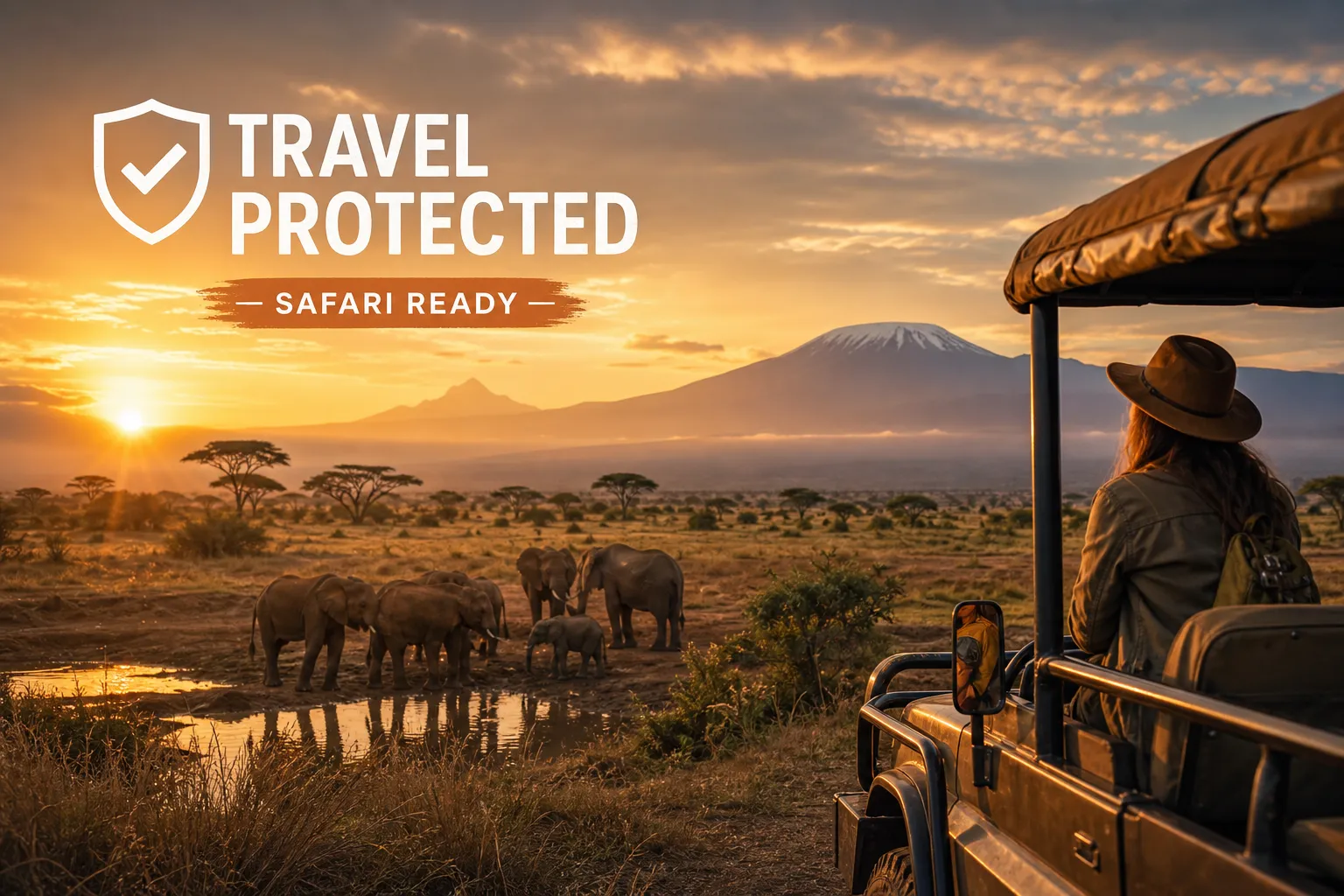
Choosing the best travel insurance for Africa means looking past the marketing summary and into the actual policy language, specifically whether it covers bush flights, sets an evacuation limit that reflects what remote Africa transport truly costs, and protects your gear at real replacement value. Most travelers don't discover the gaps until they're sitting on a bush airstrip. Picture this: you've just landed in the Okavango Delta after three connecting flights from the U.S. A six-seater Cessna is waiting to ferry you to your remote camp, forty minutes over the floodplains. You're covered, you think. You bought a comprehensive travel policy from a brand you've heard of. You're not covered. The policy defines "common carrier" in a way that excludes chartered light aircraft entirely, caps your emergency evacuation at $50,000 in a region where a full-chain extraction to a U.S. hospital can run $125,000 to $300,000 or more, and limits your camera gear to $500 per item when your telephoto lens alone cost $4,000.
These are common failure points in standard travel insurance when a trip crosses into serious safari territory, frequently overlooked gaps that this guide addresses directly. It cuts through the fine print to show you what adequate Africa coverage actually looks like, which providers genuinely deliver on the gaps that matter, and how to match a policy to the specific shape of your trip. Safari Travel Insurance was built exactly for this: destination-specific comparisons with no sign-ups, no paywalls, and no insurer jargon to decode alone.
Key gaps in the best travel insurance for Africa
Light aircraft exclusions buried in standard policies
Many comprehensive travel policies define "common carrier" to mean commercial scheduled airlines. Bush flights between camps in Botswana, Zambia, or Tanzania are routine on a safari itinerary, but they fall outside that definition entirely. If a policy doesn't explicitly name chartered aircraft or private light aircraft as covered transportation, you're flying without protection for that leg. World Nomads is notably transparent here, with policy language that explicitly covers travel as a passenger in a "private, licensed scheduled or chartered aircraft or helicopter." That's the language to look for. If you can't find it in your policy's definitions section, assume the flight isn't covered.
Evacuation caps that don't match real costs
A $50,000 evacuation limit sounds meaningful until you understand what an actual medevac from the bush costs. A realistic extraction from a remote camp in Botswana runs $15,000 to $40,000 just to reach Johannesburg. From there, repatriation to the U.S. adds another $50,000 to $150,000 or more, depending on medical complexity and required in-flight care. As an illustration of what the full chain can involve: a Tanzania-to-New York extraction accounting for the bush-plane transfer, the air ambulance leg, ICU-level in-flight support, and coordination costs can reach $282,000 or more. The planning range for the full chain from a remote safari area to a U.S. hospital is $125,000 to $300,000 or more. A policy with a $50,000 evacuation limit covers a fraction of that.
Gear limits that don't reflect what photographers carry
Standard baggage coverage applies a per-item cap, commonly $500 to $1,000, regardless of the item's actual value. A mid-range mirrorless body with a single telephoto lens already clears that figure. The aggregate baggage limit printed on the policy summary, often $1,500 to $2,500, is not what governs a claim on a single expensive item. The per-item cap does. For anyone traveling with serious photography equipment, that gap is as financially dangerous as an evacuation shortfall, and it requires a different solution: either a valuables rider that raises the per-item ceiling for declared equipment, or a standalone equipment policy that runs alongside the travel plan.
Best travel insurance for Africa: evacuation limits by destination type
Minimum thresholds by destination type
The right evacuation limit depends on where you're going and how far you are from a facility capable of treating a serious emergency. Semi-accessible safari areas with road access or a major airstrip within range set a defensible floor at $250,000. For fly-in-only camps in the Okavango Delta, remote South Luangwa, or the Masai Mara's more isolated conservancies, the correct benchmark is $500,000 minimum. For ultra-remote or multi-day overland itineraries, the planning benchmark is $1,000,000. That number isn't overcautious; it reflects the actual cost structure of a complex extraction followed by a long-haul medical repatriation to the U.S.
Countries that now require proof of travel insurance
Several African nations have made travel insurance a formal entry requirement, not just a recommendation. Kenya is the clearest example for U.S. travelers: foreign visitors must carry travel health insurance with a minimum of $50,000 in total coverage. Kenya's eTA system enforces specific sub-limits:
$20,000 for emergency medical expenses
$25,000 for evacuation
$5,000 for repatriation of remains
$1,000 for mental health treatment
$300 for prescribed medicines
These requirements are checked at arrival. Rwanda has been reported to require foreign visitors to have travel insurance or purchase it on arrival, confirm the current rule directly with Rwandan immigration authorities before departure, as official guidance can change. Similarly, Zanzibar has been reported to require mandatory inbound travel insurance for non-residents arriving by air, though the scope and enforcement of this rule should be verified against official Tanzanian government sources before you travel. For any destination on your itinerary, checking official government entry requirements directly is always advisable, as rules can change quickly.
Adventure activity coverage and camera gear: what's in, what's excluded
Which safari activities standard policies actually cover
Game drives as a passenger in an organized vehicle are the easiest safari activity to get covered under a standard plan. Guided bush walks, gorilla trekking, hot air balloon safaris, and horseback safaris are a different story. Many policies classify these as hazardous activities and exclude them without a specific activity rider or upgraded plan tier. World Nomads' Epic plan explicitly covers bushwalking. Gorilla trekking in Uganda and Rwanda is broadly associated with World Nomads' adventure-focused plans, but verify directly against the specific activity list for your policy rather than assuming it's included because the activity is popular. When in doubt, call the insurer before you buy and ask for written confirmation that the specific activity is covered.
How per-item limits work and what photographers need to do
A policy with a $2,500 aggregate baggage limit often applies a $500 to $1,000 per-item cap underneath it, and that cap is what actually governs any individual claim. World Nomads Explorer, for example, carries a $1,000 per-article limit in the U.S. version of the plan, with a valuables upgrade available for declared items like cameras and electronics. The upgrade is real but bounded: specified items can be listed up to around $1,000 each with a $2,000 total for all listed items. For a photographer carrying a $4,000 telephoto lens and a $3,500 camera body, that still falls well short.
The practical path is to document every piece of equipment with receipts and serial numbers, use the highest valuables rider your policy offers, and consider a dedicated camera equipment policy for anything the travel plan won't fully cover.
How vetted insurers stack up on safari criteria
World Nomads: strong on activities, good on evacuation headroom
World Nomads' Explorer and Epic plans offer evacuation limits of $500,000 and $700,000 respectively, both of which clear the remote safari threshold for most destination types. Their activity language explicitly covers chartered aircraft travel, and their adventure-focused plans address a broad range of guided bush activities. The trade-off is that per-item gear limits are not generous by default, and their annual plan drops evacuation coverage significantly to $100,000, far too low for serious Africa travel. For a single-trip, adventure-heavy safari itinerary, World Nomads is a reliable off-the-shelf option based on its explicit policy language around chartered aircraft and adventure activities. Photographers and annual plan buyers should examine the gaps closely before committing.
IMG and Allianz: where each earns its place and where it falls short
IMG's travel medical plans offer evacuation limits up to $1,000,000, making them particularly well-suited to travelers who already carry domestic U.S. health insurance and need a policy that wraps around it for international coverage. The medical limits are strong, and the evacuation ceiling gives genuine headroom for complex remote extractions. Allianz's OneTrip Premier plan also reaches $1,000,000 in evacuation coverage and is widely available across U.S. states. The trade-off with Allianz is that activity exclusion lists can be broader and require careful checking for bush-specific activities before you buy. Neither IMG nor Allianz explicitly flags "bush flight" or "light aircraft" coverage in the same transparent way World Nomads does, which means reviewing the transportation definitions in the actual policy document matters more with those plans.
Safari Travel Insurance's comparison guides surface exactly these distinctions, placing each insurer side-by-side against the three safari-specific failure points. Access the full breakdown with no account required and no sign-up needed.
Matching your policy to your safari profile
Remote bush camp and fly-in travelers
If your itinerary includes any fly-in-only camps, the checklist is non-negotiable. First, confirm explicit light aircraft or chartered aircraft coverage in the policy's transportation definitions. A medical evacuation limit of $500,000 is the minimum, $1,000,000 is the safer benchmark for ultra-remote destinations. Finally, verify that bush transfer flights between camps are covered as transportation legs, not just incidental activities. Ask the insurer directly: "Does this policy cover travel as a passenger on a chartered light aircraft for a bush flight between camps?" Get the answer in writing or at minimum note the date and name of the agent you spoke with.
Wildlife photographers and multi-destination planners
Photographers need to evaluate policies on a different axis than standard travelers. Three questions matter most: What is the per-item limit on declared equipment? Is a valuables rider available, and what does it actually pay per declared item? What documentation does the insurer require to process a gear claim? The answers vary significantly between providers. The difference between a $500 per-item cap and a $1,500 per-item cap can mean the difference between a covered claim and a $3,000 out-of-pocket loss on a single lens.
Multi-destination planners combining a beach extension in Zanzibar with a Kruger safari and a city stay in Nairobi, or anywhere else across travel insurance for South Africa and East Africa routes, need to confirm that coverage applies uniformly across all legs, not just the primary destination. Some policies define the covered region by the first destination declared or exclude legs to beach or urban areas if the policy is promoted as safari-specific. Check the geographic scope section carefully and flag every country on your itinerary when you buy. Safari Travel Insurance's destination-specific guides are built around each location's risk profile and the coverage criteria that matter there, so you're not relying on a generic Africa guide and hoping your specific destination fits.
Getting the best travel insurance for Africa before that first bush flight
The best travel insurance for Africa is not the most expensive policy or the most familiar brand name. It's the one that explicitly covers bush flights, sets an evacuation limit that reflects what remote Africa transport actually costs, and handles your gear at real replacement value. Every safari itinerary has a different risk profile, and the only way to confirm genuine fit is to check the actual policy language against your specific trip, not the marketing summary on the insurer's website.
Safari Travel Insurance makes that check fast and clear. The guides are destination-specific and activity-specific, evaluating vetted partners on the criteria that matter in the bush rather than the criteria designed for city-break travelers. No account required, no sign-up. Start with the comparison that matches your trip profile, confirm your evacuation threshold against your most remote destination, and verify your gear limits before you board that first bush flight. The best Africa travel insurance is the one secured before departure, because it's the only one available to you when you need it most.