Does travel insurance cover expensive cameras on safari?
August 29, 2026· By InsuranceSafari Research Team· Safari Travel Insurance editorial team· 11 min read
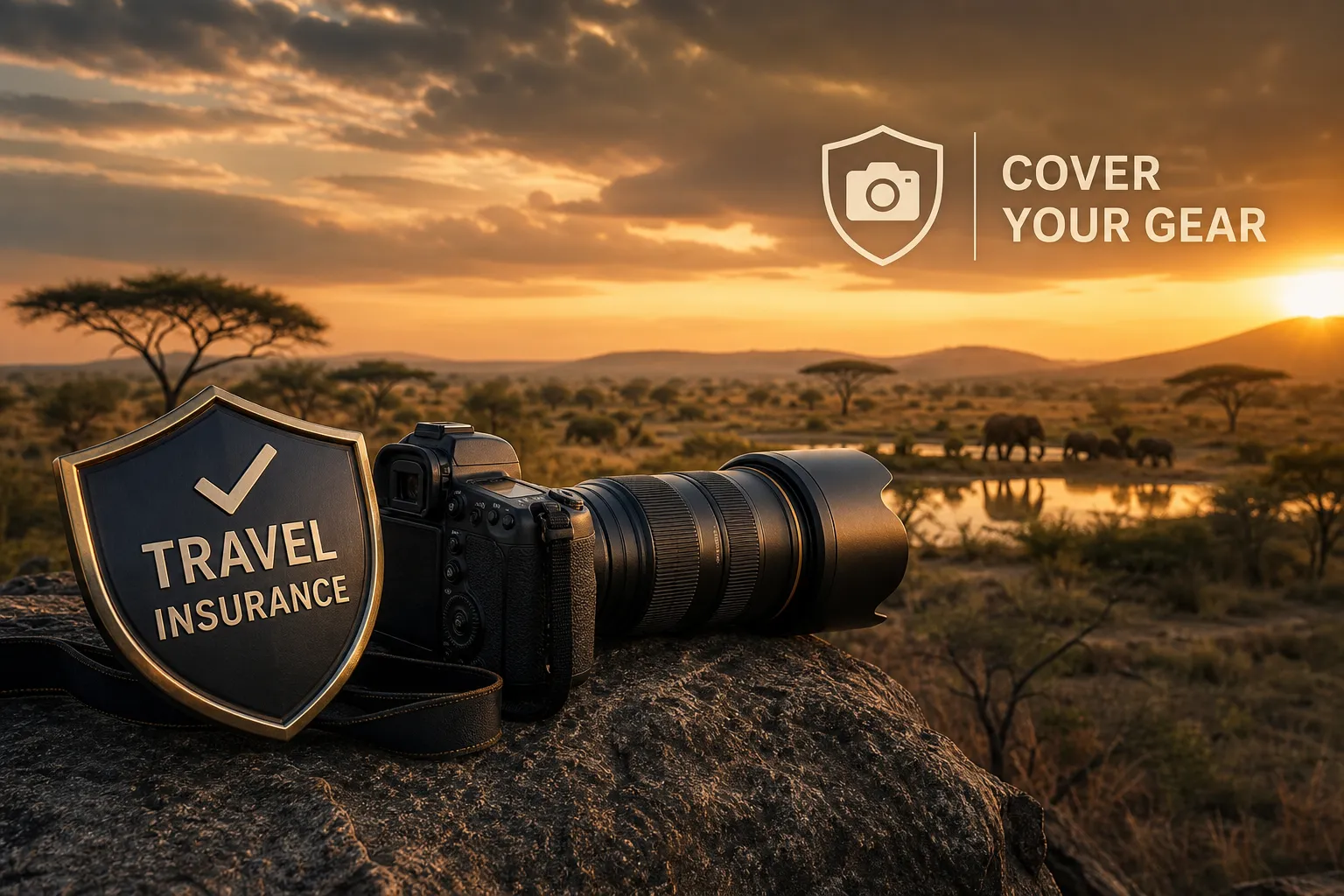
Picture this: you've just landed in Nairobi, connecting to a charter flight into the Masai Mara with a camera bag holding $15,000 worth of bodies and glass. You booked a solid travel insurance policy, paid the premium, and assumed the gear was covered. Six days later, a smash-and-grab at camp takes your primary body and a 500mm prime. You file the claim. The insurer pays $500 per item, the standard cap buried in the baggage section, and closes your ticket. The total payout is $1,000 on $13,500 worth of gear. That gap is real, common, and entirely avoidable if you know what travel insurance covers for expensive cameras on safari before you leave home.
Standard travel insurance and expensive safari camera rigs are a bad match by default. The policies were not designed for $12,000 telephoto lenses, and the exclusions they carry line up almost perfectly with how theft and damage happen in the bush. This guide walks through how baggage sub-limits actually work, when a scheduled item rider fixes the problem, when a specialist equipment policy is the better call, and what documentation you need on hand before you board.
Why standard baggage cover leaves safari photographers short
Standard travel insurance treats cameras as personal effects, which means they fall under the baggage benefit. The number that matters is not the total baggage limit printed on the summary page. It is the per-item cap, a separate figure that determines the maximum payout for any single piece of equipment regardless of what everything is worth in total.
Most standard policies set that per-item limit at $250 to $500. Better comprehensive plans push it to $1,000 or $1,500. A mid-range 100-400mm zoom lens costs more than the entire per-item allowance on a basic plan. The total baggage headline looks generous until you read the actual wording.
The sub-limit structure makes this worse. Many policies advertise total baggage cover of $5,000 to $8,000, which sounds like enough. But cameras and electronics frequently sit inside a separate electronics or valuables sub-limit that is lower than the overall total. A $7,500 baggage benefit with a $500 electronics sub-limit pays out $500, full stop. The headline number is irrelevant once that internal cap applies.
Run the numbers on a realistic safari kit: a mirrorless body at $3,500, a 500mm prime at $12,000, a backup body at $2,800, two lenses totaling $4,000, and accessories worth another $700. Replacement value sits around $23,000. Under a standard travel policy with a $500 per-item cap, the maximum realistic payout across the entire kit rarely exceeds $1,500 to $2,000 even if every item is claimed. That $21,000 gap is the core problem this article addresses.
What travel insurance covers for expensive cameras on safari: baggage limits and scheduled items
A scheduled item rider, sometimes called a specified items endorsement or declared-value add-on, changes the structure entirely. Instead of lumping your camera body into a general electronics bucket, you list each piece of equipment individually: make, model, and insured value. If that item is stolen or destroyed, the settlement is calculated against the declared amount, not the default sub-limit.
The catch is that not all travel insurers offer this for camera gear. Some allow scheduling only for jewelry. Others cap the declared value at $1,000 to $2,000 per item, which still falls short for a $12,000 lens. The right question to ask before committing to any policy is whether cameras can be individually scheduled and what the maximum declared value per item is. If the insurer cannot answer that clearly, the policy is not built for serious photography gear.
When a scheduled add-on is available through a travel insurer, the cost is typically $1.50 to $2 per $100 of insured value annually. A $6,000 kit might run $90 per year as a rider. A $10,000 kit lands around $150 to $300 annually depending on the insurer and coverage tier. That is a meaningful but manageable cost compared to carrying an uninsured $15,000 rig into the bush.
Understanding what travel insurance covers for expensive cameras on safari is the specific policy detail that generic comparison sites miss or bury. Safari Travel Insurance publishes side-by-side gear coverage comparisons across vetted insurers, flagging exactly how each partner handles per-item camera limits and whether scheduled item riders are available at all. You can check that information directly without reading through full policy documents or calling insurers one by one.
How to schedule lenses and bodies correctly
List each item separately by make, model, and serial number when submitting a scheduled rider application. Insurers require this level of specificity to bind coverage at the declared value. Grouping items under a single line, "camera kit, $15,000", is not sufficient and may revert to the standard per-item cap at claim time. If a lens is purchased after the policy inceptions, notify the insurer immediately to add it to the schedule; coverage does not extend automatically to newly acquired gear.
Expected rider cost by kit value
At the standard rate of $1.50 to $2 per $100 of insured value, a $5,000 scheduled kit adds roughly $75 to $100 per year to a travel policy. A $15,000 scheduled kit runs $225 to $300 annually. Some insurers charge a flat endorsement fee on top of the per-$100 rate, so confirm the full cost structure before assuming the advertised rate is all-in.
Specialist camera insurance vs. travel policy riders: which fits your rig
For photographers carrying $3,000 to $6,000 in gear on an occasional safari, a scheduled item add-on through a travel insurer is often the most practical solution. It consolidates trip cancellation, medical evacuation, and gear coverage into a single policy. The key requirements are that the declared value per item matches replacement cost and that the policy explicitly covers theft, accidental damage, and loss in transit under the same terms.
Photographers carrying $10,000 or more in equipment, especially those traveling regularly or shooting across multiple destinations, are usually better served by a standalone equipment policy. In the U.S. market, inland marine floaters and equipment floaters through carriers designed for photographers cover gear to its full replacement value. Annual premiums typically run around 1 to 2 percent of insured value. A $20,000 kit might cost $150 to $400 annually under a standalone policy, often with a $0 to $350 deductible on scheduled items. Providers like Front Row Insurance and InsureMyEquipment are built around this structure, with policies designed to cover exactly the risk profiles that standard travel insurance excludes.
Four policy terms determine whether any claim actually pays out, regardless of which route you choose. Converting the prose list to something clearer: valuation basis (replacement cost covers what the item costs new; actual cash value subtracts depreciation and leaves you short on expensive gear); deductible per item (lower is better for high-value cameras); professional use inclusion or exclusion (this is critical and covered in detail in the next section); and the specific list of covered perils (theft, accidental damage, and loss in transit are the minimum standard for safari use). Replacement cost valuation and a low per-item deductible are the benchmarks to insist on regardless of policy type.
When travel insurance covers expensive cameras on safari, and when exclusions block the claim
Unattended gear is the most common reason camera theft claims are denied. Most policies define "unattended" as equipment left without direct supervision, where you are not physically close enough to prevent it from being taken. A camera bag left on a lodge table while you walk to the buffet qualifies. Equipment left on a vehicle seat during a bush walk qualifies. Gear sitting in an open daypack at camp while you are inside the tent qualifies. Reasonable care in a safari context means the camera is on your body, in a closed bag in your direct possession, or locked in a room or vehicle with evidence of forced entry if taken.
Theft from vehicles is typically covered only when there is evidence of forced entry and the vehicle was locked at the time. A camera bag visible on a back seat with no sign of forced entry is one of the most common denial scenarios in safari travel claims. The insurer's position is straightforward: no forced entry means no evidence of theft, and the claim is denied on those grounds.
Professional use exclusions catch photographers who did not read the fine print. Standard travel policies often void the claim entirely if the gear was being used for paid work at the time of loss. That wording is broad enough to cover freelance assignments, commercial shoots, and even selling images after the fact in some policy interpretations. If you earn income from photography and plan to work on the safari, you need a policy that explicitly includes commercial use.
The safari environment creates additional damage scenarios that most policies exclude. Dust, humidity, and vibration from dirt roads are treated as wear and tear or gradual deterioration, excluded perils under virtually every standard policy. Wildlife interaction is more nuanced: damage caused by an animal may be excluded if the insurer classifies it as animal damage rather than a sudden insured event, so check the perils list carefully if your itinerary includes open vehicles in close wildlife contact.
War and civil unrest exclusions are standard across the market. They apply to certain African destinations when travel advisories are active at the time of departure, so confirm your specific destination's advisory status before purchase.
Pre-departure documentation and what to do after a loss
The most common reason a valid claim still fails is insufficient proof of ownership and value. Before any safari with serious camera equipment, build a documentation kit for every item you are carrying. Photograph each piece clearly, capturing the serial number label on each body and lens. Save digital copies of purchase receipts or original invoices in cloud storage, and email a copy to yourself so you can access it from anywhere. Record the make, model, serial number, purchase date, and purchase price for every item in a simple inventory document, and store that list in at least two places: cloud storage and as an email attachment. If you purchased equipment secondhand, a professional appraisal from a certified gear appraiser serves the same purpose as a purchase receipt for insurers who accept valuations in lieu of original invoices.
Before you fly, confirm three specific things on your policy: the per-item limit for cameras, whether your specific gear is listed by name on the policy, and exactly how the policy defines "unattended" and "professional use." If anything in the wording is ambiguous, contact the insurer and get the clarification in writing before departure. Also research the local police reporting process for your destination. Theft claims universally require a police report, and some insurers require it within 24 hours of the incident, which means knowing where to go before something goes wrong.
If theft or damage occurs on safari, report it to your camp or guide immediately to create a dated record. File a police report as soon as you can reach the nearest station. Photograph the scene, including any forced entry or visible damage to the location. Contact your insurer's claims line before leaving the country if the loss is significant. Document everything in writing with timestamps, and keep copies of every communication through to settlement.
Getting the right coverage before you depart
Expensive camera gear and standard travel insurance are a mismatch by design. Per-item caps, baggage sub-limits, and exclusions around unattended property and professional use are built into most policies, and the safari environment creates exactly the conditions those exclusions were written to cover. Knowing what travel insurance covers for expensive cameras on safari before you leave home, not after a claim is denied in the field, is the only way to close that gap.
Whether you need a scheduled item rider on a travel policy, a standalone equipment floater, or a specialist photography policy depends on the total value of your kit and how often you travel with it. A $5,000 rig on an occasional trip is a different calculation than a $25,000 professional kit used across multiple destinations per year. Both problems have solutions, but only if you identify the right one before departure.
The gear coverage comparisons at Safari Travel Insurance break down exactly how vetted insurers handle per-item camera limits, scheduled item availability, and professional use exclusions, so you can evaluate policies on the criteria that actually matter for safari photography. Check those comparisons, confirm your coverage terms in writing, and bring your documentation kit on every trip. The gear you protect before you leave is the gear you can replace without covering the cost yourself.